Regular-investing discounts can make recurring contributions cheaper, but a headline saving is only one part of the cost picture. For a self-directed investor, the useful comparison is between the published terms of each account and the way they expect to use it: contribution frequency, investments held, occasional trades and any overseas dealing. This is general information, not personal financial advice.
What Regular-Investing Offers Actually Change
AI-generated generic editorial illustration — not a retailer product photo and does not depict the reviewed product or service. Clarify that regular-investing offers should be assessed across several published cost categories rather than as a standalone headline saving.
 A regular-investing offer usually changes the cost of placing scheduled contributions. It does not necessarily remove the other charges associated with an investment account. Hargreaves Lansdown says there are no dealing charges when investments are made by monthly Direct Debit, while its account charge is an annual charge billed monthly and based on the value of investments. [ev_065d94532a1f9681]
That distinction matters. A platform can have an account charge, a charge for individual buys or sales, and investment-specific charges at the same time. Hargreaves Lansdown notes that some investments have charges set by the fund manager or provider; these can be found in the relevant investment document. [ev_065d94532a1f9681] AJ Bell likewise describes an account charge payable monthly and a dealing charge for each purchase or sale of shares or funds. [ev_07b39445eb0bffdf]
Before judging an offer, identify the account you would use and the activity it covers. A scheduled contribution into an eligible investment may have different terms from an unscheduled purchase, a sale, or a trade in an overseas share. The result is that “no charge for regular investing” is a defined dealing feature, not a statement that every cost of investing has disappeared.
Where Regular Investing Can Create Genuine Savings
Regular investing can create a measurable saving when it replaces repeated transactions that would otherwise attract a dealing charge. Hargreaves Lansdown states that there is no charge for regular monthly investing by Direct Debit, while dealing charges are what customers pay each time they buy or sell an investment. [ev_065d94532a1f9681] For someone who would otherwise make separate eligible purchases at the normal transaction terms, the difference between those published terms is the starting point for assessing a saving.
The comparison works best when the planned pattern is stable. List the likely monthly contribution, the investments to be bought, and whether the purchase can actually be made through the platform’s regular-investing route. Then separate those scheduled purchases from any individual transactions. An occasional standalone trade may be charged differently even if the recurring contribution is not.
A saving is also more meaningful when it is considered over the period you expect to hold the account. Account charges may be annual percentages collected monthly, as both supplied charge pages describe. [ev_065d94532a1f9681] [ev_07b39445eb0bffdf] A lower regular-dealing cost can therefore be valuable without being the only relevant cost.
The sensible calculation is not a forecast of investment returns. It is a comparison of published charges for the same expected account use: scheduled contributions, any individual dealing, account value and relevant investment or overseas costs. If the expected use changes, repeat the comparison rather than assuming the original offer will remain the best fit.
Potential Advantages Beyond the Headline Offer
The practical appeal of regular investing is not limited to a lower scheduled-dealing charge. Setting a recurring contribution can make the timing and amount of planned purchases more predictable. That may make it easier to distinguish routine investing from extra, ad hoc trading when reviewing costs.
Published charge pages can also help readers make a more transparent comparison. Hargreaves Lansdown separates account charges, dealing charges and charges that some investments carry themselves. [ev_065d94532a1f9681] AJ Bell separately describes its account charge, dealing charge and an additional foreign-exchange charge for international share trades. [ev_07b39445eb0bffdf] Looking at these categories together is more informative than comparing a single promotional phrase.
Convenience and cost should remain separate. A regular instruction may be convenient because it creates a repeatable process, but convenience does not establish that an account is cheaper for every investor. Nor does a discounted regular contribution say anything by itself about the suitability or performance of an investment. Use the published terms to compare costs; make investment decisions through the appropriate research and, where needed, regulated advice.
Costs and Restrictions That Can Reduce the Value
An offer can look attractive while leaving substantial costs unchanged. Hargreaves Lansdown describes an account charge based on investment value, billed monthly, and notes that some investments have charges set by their manager or provider. [ev_065d94532a1f9681] These charges should be checked alongside any reduction in scheduled-dealing cost, particularly as the amount invested grows.
Individual activity can also alter the result. Hargreaves Lansdown defines dealing charges as charges paid when buying or selling an investment and illustrates a situation where regular monthly investments sit alongside an individually bought fund and an individually sold share. [ev_065d94532a1f9681] In other words, a regular-investing term may cover the recurring part of the plan without covering every trade around it.
Overseas investing needs its own line in the comparison. Hargreaves Lansdown says extra charges apply when buying overseas shares. [ev_065d94532a1f9681] AJ Bell says international share transactions carry a dealing charge and an additional foreign-exchange charge. [ev_07b39445eb0bffdf] A low domestic regular-dealing cost may therefore be less important for an investor whose expected activity includes overseas shares or foreign-currency funds.
Finally, check the operational restrictions in the current published terms: which account, payment method, investment type and transaction route qualify; whether there are minimums or dealing dates; and what applies to sales or changes. Do not assume that a regular-investing feature applies to all assets or all ways of placing an order.
A Practical Framework for Comparing Platform Offers
AI-generated generic editorial illustration — not a retailer product photo and does not depict the reviewed product or service. Support a neutral, repeatable comparison process using the charge types surfaced in the admitted official evidence.
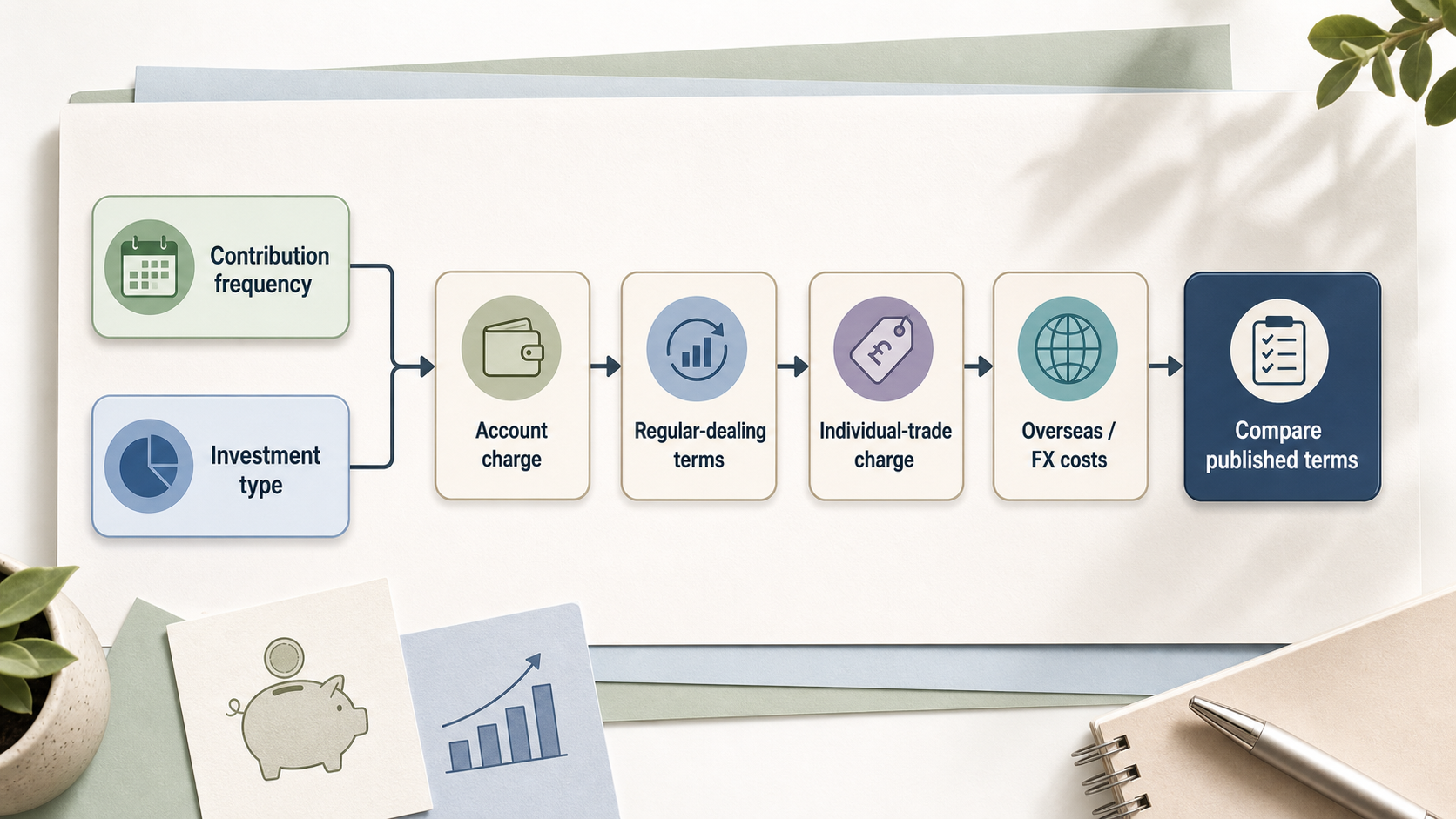 Use one consistent scenario for every platform you are considering.
- Describe your expected pattern. Record the planned contribution amount and frequency, the account type, the investments you expect to hold, and whether you expect occasional individual purchases or sales.
- Check the regular-investing terms. Confirm whether the scheduled contribution is eligible and what published dealing charge applies. Hargreaves Lansdown states that monthly Direct Debit investing has no dealing charge, but that statement should be read with the account’s current terms. [ev_065d94532a1f9681]
- Add the account charge. Include any annual or monthly account fee, and understand what balance or holdings it is calculated from. Both supplied sources describe account charges paid monthly. [ev_065d94532a1f9681] [ev_07b39445eb0bffdf]
- Add non-routine dealing. Price the individual buys and sales you realistically expect. AJ Bell describes dealing charges as applying each time shares or funds are bought or sold. [ev_07b39445eb0bffdf]
- Add investment and international costs. Check fund or provider charges where relevant, plus overseas dealing and foreign-exchange charges if you intend to use them. [ev_065d94532a1f9681] [ev_07b39445eb0bffdf]
- Read the restrictions before acting. Compare the current published terms rather than relying on a headline alone, and revisit the exercise if your contribution pattern or holdings change.
This framework does not produce a universal winner. It gives you a repeatable way to compare the charges that apply to your own intended use, while keeping a platform offer distinct from an investment recommendation.
Frequently Asked Questions
Do regular monthly investments always avoid dealing charges?
No. The answer depends on the platform’s published terms, the payment route and the investment involved. Hargreaves Lansdown says there is no charge for regular monthly investing via Direct Debit, but it separately defines dealing charges for buying and selling investments. [ev_065d94532a1f9681] Check that your planned instruction qualifies before relying on a no-charge term.
Can a low or discounted dealing charge still be outweighed by platform fees?
Yes. A scheduled-dealing saving should be considered alongside account charges and any investment-specific costs. Hargreaves Lansdown describes an account charge based on investment value, while AJ Bell describes an annual account charge payable monthly. [ev_065d94532a1f9681] [ev_07b39445eb0bffdf] Whether one cost outweighs another depends on the published terms and your expected use.
Which published charges should I compare before choosing a self-directed investment platform?
Compare the account charge, the charge for regular and individual dealing, charges linked to the investments you plan to hold, and overseas or foreign-exchange charges where relevant. The supplied official pages explicitly separate these categories. [ev_065d94532a1f9681] [ev_07b39445eb0bffdf] Also check eligibility rules and transaction restrictions in the current terms.
Recheck current product details, measurements, delivery terms and return conditions before ordering.
Sources
Related reading
- InvestEngine review: fees, ETF-only range, and practical trade-offs
- How to compare UK investment platforms by account type, dealing pattern, and support
- How investment platform fees work across funds, shares, ETFs, and foreign exchange
- How to verify investment platform promotions, transfer terms, and warning signs
Editorial information: About our editorial team · Read our editorial policy · Read our affiliate disclosure.